by Br. Lawrence Humphrey FSC
Introduction and Acknowledgments
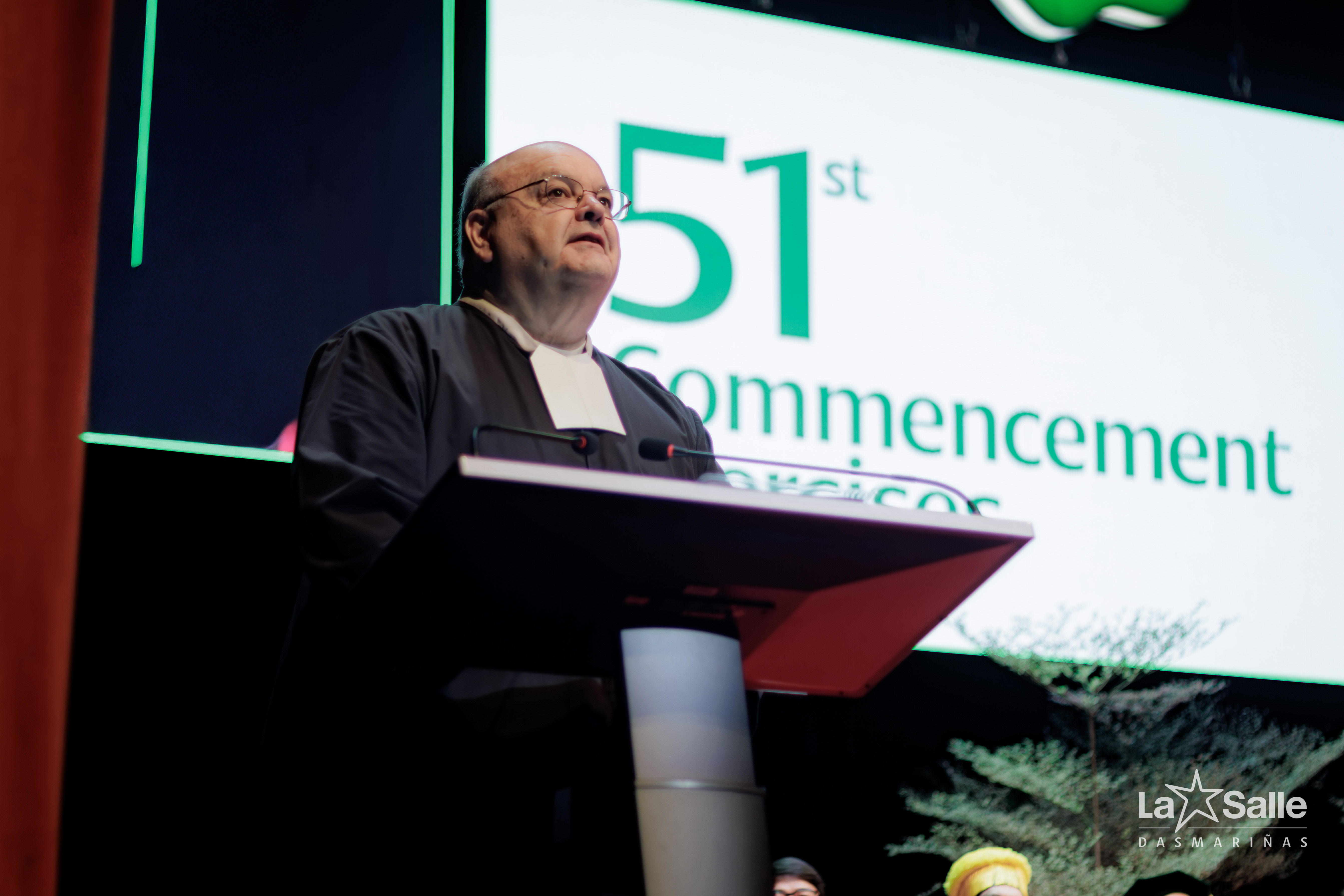
Brother Inigo Riola, President, members of the Board of Trustees, distinguished faculty, dedicated staff, proud parents, honored guests, and above all, the resilient, triumphant Graduating Class of DLSU-Dasmariñas of 2026!
Good morning.
Look around you today. Take a deep breath. Feel the weight of the gown you are wearing and the cap resting on your head. A day that at one time may have seemed so far away is now upon us. You made it.
Before we dive into the grand horizon of your future, let’s take a moment of radical gratitude. Graduates, look around this theatre, at the faces scanning the crowd just to catch a glimpse of you. The parents, moms and dads, grandparents, aunts, uncles, and partners who sacrificed for you, worried about you, and offered quiet prayers when you thought you couldn't pass that final exam or defense. They are here to celebrate you today. Let’s give them the thunderous applause they deserve.
And let’s not forget the incredible faculty and staff of DLSU-D. You didn’t just teach out of textbooks; you mentored, challenged, and modeled for these graduates what it means to be Lasallian.
You know, a few months ago, when Brother Inigo first invited me to be your commencement speaker, I thought, “How Nice.” What an honor to be invited to share a few thoughts with you this morning. But while considering what I might say, I thought back to my various school commencement addresses, and I suddenly realized that I don’t remember a word that was spoken at any of my graduation ceremonies, although admittedly they were quite a few years ago. Nevertheless, let us continue.
The Unique DLSU-D Experience: Looking Back
Every university has its traditions, but I sense there is something deeply magical about the La Salle Dasma campus. You didn't just earn a degree; you lived an experience that is uniquely yours.
Think back to your first days stepping onto its sprawling, beautiful green campus. Think of the walks under the shade of the trees, the sudden Cavite downpours where you had to share an umbrella with a total stranger, and the hours spent studying—or daydreaming—near the lake.
Think of the frantic group study sessions, the endless rows of jeepneys outside the gates, the comforting taste of your favorite campus street food, and the distinct pride of wearing the green and white.
But your journey wasn't just defined by the beautiful scenery. It was forged in fire. Your batch faced unprecedented shifts in how education is delivered. You adapted to screens, navigated hybrid setups, wrestled with fluctuating internet connections, discovered AI, and fought through the isolation of a changing world. Yet, you kept showing up. You didn't just survive; you adapted, you evolved, and you conquered.
The Three Pillars of a Lasallian
As you prepare to step outside the gates of DLSU-Dasmariñas, you might be asking yourself, "What now? Who am I supposed to be in a world that feels so chaotic and unpredictable?"
The answer isn't written in the stars; it’s already woven into the fabric of your identity. It is found in the three core pillars that St. John Baptist de La Salle left behind for us: Faith, Zeal for Service, and Communion in Mission.
1. Faith: Your Internal Anchor
In the corporate world, in the labs, in business meetings, in the service and hospitality industry or wherever your path leads, your faith will be questioned. I don’t just mean religious faith, but faith in humanity, faith in your purpose, and faith in your own worth. When the world tells you to compromise your integrity for a quick win, remember the quiet confidence you learned here. Let your faith be your internal compass.
2. Zeal for Service: Excellence with a Soul
To have "zeal" means to do things with burning passion. But a Lasallian’s zeal is never selfish. It is never just about climbing the corporate ladder or adding zeroes to a bank account. It is about service. As De La Salle Univesity-Dasmariñas graduates, you are called to be excellent—not just to be the best in the world, but to be the best for the world. If your success doesn't lift someone else up, you haven't truly succeeded yet.
3. Communion in Mission: Building Bridges, Not Walls
We live in a deeply polarized world. People love to build walls and echo chambers. But you have been trained in communion. You have learned the value of community, of collaboration, and of looking out for the last, the lost, and the least. Wherever you go, be a bridge-builder. Bring people together.
The World Beyond the Gates
Let’s be honest for a moment. The world out there is loud. It’s fast. It changes at the speed of an algorithm. You will face rejection. You may send out resumes and hear silence. You might start a job and realize it’s not your dream.
When those moments happen—and they will—I want you to remember something crucial: Failure is not the opposite of success; it is a stepping stone to it.
"Do not be dispirited by the difficulties you experience," St. John Baptist de La Salle once wrote.
When you feel lost, remember the resilience you built right here in Cavite. Remember that your degree is not a guarantee of a smooth life, but a toolkit proving you have the grit to handle the rough patches. You are Lasallians. We don't fold under pressure; we flourish in the face of it.
Charge to the Graduates
So, Class of 2026, here is my challenge to you as you stand on the precipice of the future:
- Be disruptors of apathy. When you see injustice, do not look away. Use your skills in business administration, accountancy, entrepreneurship, in tourism and hospitality management, science and technology, to create solutions, not excuses. For some of you, maybe it’s time to consider becoming a De La Salle Brother!
- Keep learning. Your graduation today marks the end of your formal college education, but it is the matriculation day for the rest of your life. Remain curious. Remain humble enough to know you don't know everything.
- Carry the green and white with humility. Let your character speak louder than your credentials. Let your kindness be your calling card.
Conclusion: Animo La Salle!
The long nights of studying are over. The nervous anticipation of final grades is behind you. The future is no longer a distant dot on the horizon—it is standing right in front of you, waiting for you to claim it.
Go out there and make your families proud. Go out there and make your country proud. Go out there and make your Alma Mater proud.
It doesn’t really matter if a year from now, or even 10 or more, if you remember any8tng I’ve said this morning. What matters is that, as you leave the halls of De La Salle University-Dasmariñas today, carry the light of St. John Baptist de La Salle into the darkest corners of the world. With faith as your internal compass and kindness as your calling card.
Live Jesus in your hearts—not just today, not just tomorrow, but forever.
Congratulations, DLSU-D Class of 2026!
Animo La Salle! Thank you, and good morning!