LEAD Story 453

“By their fruit you will know them.” — Matthew 7:16

December 1st marked a quiet yet meaningful moment of connection here in Hakodate. I accompanied four Junior High School students who eagerly accepted the invitation to join a simple activity with the students of the Hakodate School for the Deaf. The initiative was led by Ms. Natalie Correia, who participated in the PARC Justice and Peace Workshop in Malaysia last September 2025.

Though the walk from our school took only ten minutes, the warmth that awaited us at the end of that short distance was immeasurable. We were greeted by bright smiles from the students and teachers—an instant atmosphere of openness, welcome, and joy.

The activity itself lasted less than an hour, but every minute reflected a sincere desire to build friendship and understanding. Its simplicity made the encounter even more powerful. In those brief moments, we shared not only activities but also kindness, curiosity, and mutual respect. As the session concluded, I found myself wishing we could have stayed longer—and hoping we can return in the near future with more young Lasallians.

This experience captures the heart of the Leavening Movement taking root even here in Japan. Lasallians—teachers and students alike—become “leaven” when we take part in small, almost invisible acts that foster meaningful change, even if their effects unfold quietly at first.

These gestures may be modest and unassuming, yet they rise into something potent, transformative, and profoundly human. Our visit may have been short, but its spirit continues to grow—in us, in them, and in the gentle reminder that small acts, done with sincerity, can help shape a more compassionate and fraternal world.
 

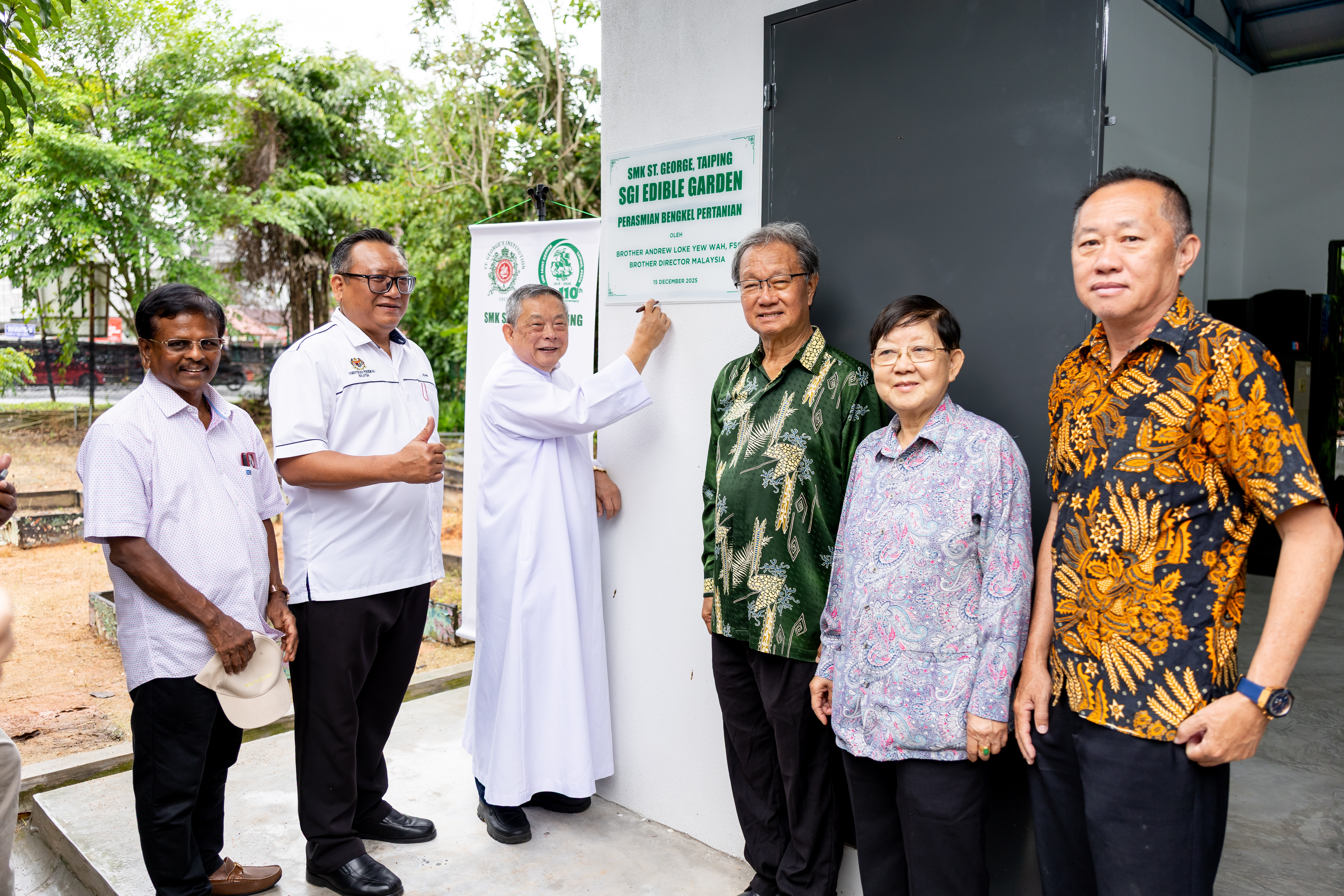
December 15, 2025: St. George’s Secondary School in Taiping held three major events today: the official opening of a vegetable and fruit garden workshop, the naming ceremony of the school field, and the closing ceremony of its 110th Anniversary celebrations. The events were witnessed by Brother Andrew Loke Yew Wah FSC, La Salle Brother Director for Malaysia, members of the Board of Governors, teachers and students.

At the opening ceremony, Board Chairman Joseph Lau Tee Sun said the school has maintained a vegetable and fruit garden since the 1960s. He added that the Board of Governors had spent RM70,000 to build a new workshop for students taking agricultural studies. The workshop is located within the school’s Fruit and Vegetable Garden, known as the ‘SGI Edible Garden’.

He explained that the garden allows students to experience farming first-hand, deepen their understanding of agriculture, and cultivate interest and patience, as growing fruits and vegetables requires time and care before harvest.

At the school field naming ceremony, Joseph Lau noted that the field has a long history and has recently been upgraded, with murals painted by renowned artist Dato’ Chen Teck Ming, making it particularly meaningful.

He urged students from both the secondary and primary schools to make full use of the field by participating more actively in sports and co-curricular activities, thereby bringing honour to the school. He also announced that the school’s 110th Anniversary celebrations were drawing to a close and thanked everyone for their unity and support, which ensured the smooth running of all events.

The principal of St. George’s Secondary School, Taiping, Mohd Izam bin Mohd Ramly, said the vegetable and fruit garden workshop enables students to participate in agricultural activities and gain a deeper understanding of farming, science and technology. He added that such activities also strengthened interaction among students and fostered teamwork.

Br Andrew, who officiated at the opening of the workshop, the school field naming ceremony and the anniversary closing ceremony, said the opening of the workshop and the naming of the field symbolise a meaningful new milestone for the school.

He thanked Board Chairman Joseph Lau, Board members and dedicated educators for their long-standing care and support, which have enabled the school to continue thriving as a respected institution. He encouraged students to learn with humility and strive to bring honour to the school.

Guests at the field naming ceremony included St. George’s Primary School headmistress Puan Khairiah,  Paul Loh, Madam Choong Yan Tai and Dato’ Chen Teck Ming, among others.
 

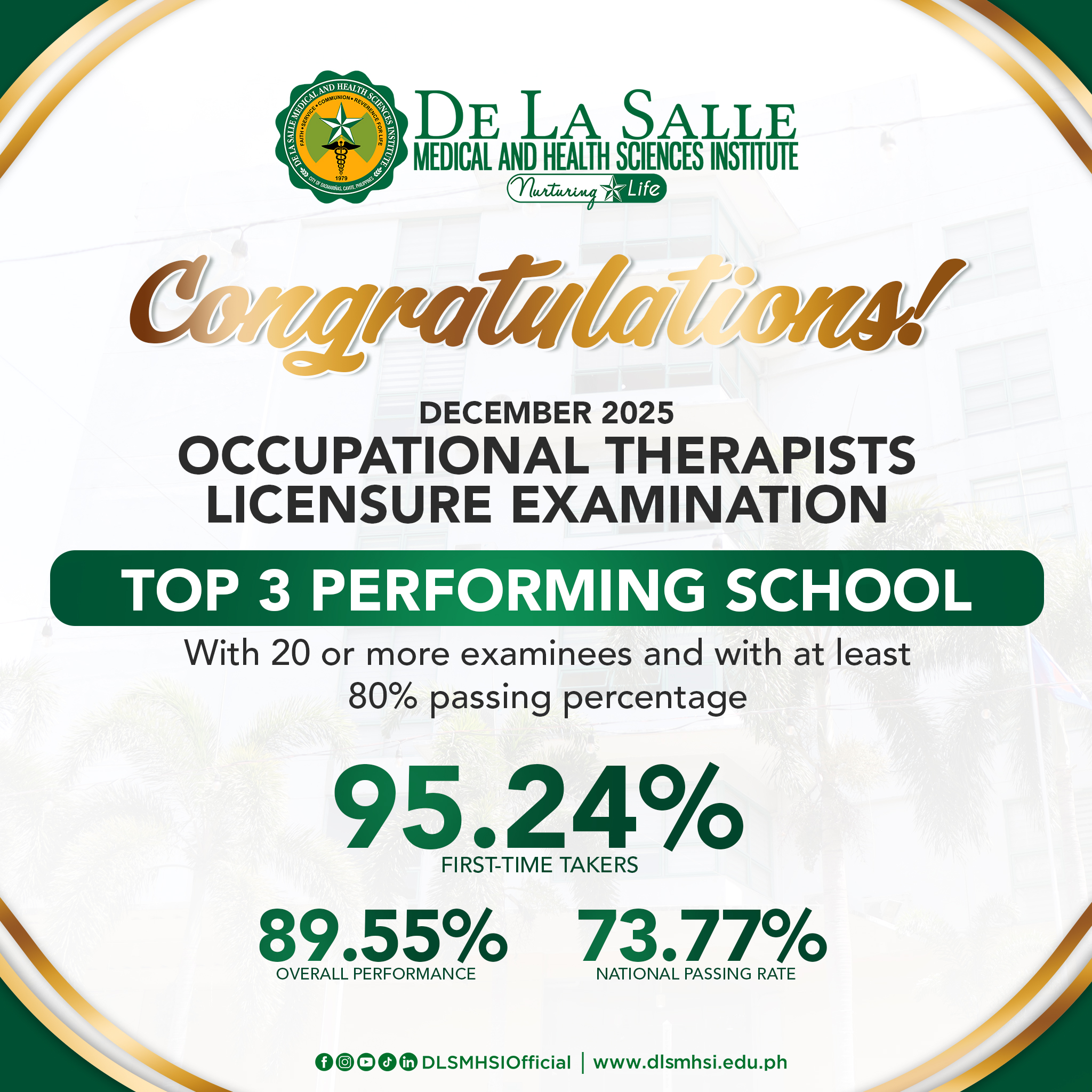
The Lasallian community at De La Salle Medical and Health Sciences Institute proudly celebrated a historic achievement of having 15 topnotchers from the school in the December 2025 Occupational Therapists Licensure Examination (OTLE). It has also ranked 3rd among the top-performing schools and accomplished a 95.24% passing rate for first-time takers and 89.55% overall performance.

Since August, the school also scored excellent results in the licensure exam for physicians, medical technologists, speech language pathologists, pharmacists, nurses and physical therapists.

You may know more about DLSMHSI through its recent annual report video: https://www.youtube.com/watch?v=OSDEld3QihE

By Br. Rodrigo Treviño FSC

After a stormy trek on the decision-making processes’ determining my participation in the EAPI’s Sabbatical, I arrived in Manila in the morning of August 4th, the very first day of the program. Jet-legged and after throwing unto the bed my luggage, I proceeded to the “Terrace” to face around 60 faces seemingly from all over the world, much more than the 20 to 25 that I was expecting according to the brochure of the sabbatical program. This was the first signal that something was caught wrong in my mind. I learned, on that Orientation session, that some parts of the program will be together with participants of another program the PRD. God started His beautiful writing in my crooked heart.

After a heavy rain of names of people and countries (just few remained in my mind at that time), and some information about the program, the facilities and organization, three days of generalities and a TRIDUUM (you know, three days) of semi-retreat, we were kind of equipped for what resulted on 17 weeks of a wandering and wonderful program. 

I can risk to say that our “8 days silence retreat” (exactly in the middle of the program, in a town called Tagaytay, was the navel of the program for me! The retreat was preceded by weekly modules on relearning to learn, spirituality and psychology, digital prophecy (which led me to the practical discovering of ChatGPT and other tools), discernment and aesthetics of self-care (which helped me to rediscover that during the process of the creation of my wonderful self I skipped a visit to the art & creativity department!) With the converging ideas of both Ignatian and Lasallian spirituality on God’s immanence, the practice of the Ignatian Exam and the Lasallian habit of the hourly inner recollection of the presence of God, helped me a lot to go deeper into the concept of “long, loving, look to the real” promoted through William McNamara and which have been a pivotal axis in my personal annual plan. The retreat was followed for a week-long break, resumed by modules on perspectives on self-guarding, ecological conversion, affective maturity and others that consolidated the beautiful God’s hand-writing on my somehow crooked heart.

AI

It be a “crime against humanity” if I do not recognize that God’s handwriting quite frequently comes through some or many of His clerks. God’s hand writing through the passion, enthusiasm, devotion and dedication, courage and commitment, joy, smiles and laughter of the participants pierced through my crooked heart coloring it into a canvas titled: GRATITUDE.

Of course, we know that in a pluralistic group as ours, diversity and unity without uniformity is a formidable challenge which, by the way, we were able to face and to overcome graciously. Just putting all the crayons in the same box doesn’t make a rainbow, but we manage to make a rather beautiful panoramic mural. That’s a reason why in my heart the word GRATITUDE resounds loudly.

I want to extend my gratitude to the District and to the Japan Sector Brothers who encouraged me and facilitated my participation in this four months Sabbatical Program on EAPI of Ateneo de Manila. Now, going back to Hakodate to try to continue serving God to the best of my capabilities. THANK YOU VERY MUCH!!!

Thank you


The very first Lasallian East Asia District (LEAD) School Leaders Congress took place in Hong Kong on 8 & 9 December 2025 at the Royal Plaza Hotel. A total of 110 school directors, supervisors, principals, vice principals and school administrators from six countries of LEAD attended the two-day event.

The Congress aimed for school leaders to collaborate and share resources to ensure the mission adapted to contemporary challenges and remained sustainable for future generations. School leaders were encouraged to initiate collaborative networks, share successful practices, and commit to ongoing dialogue.

The keynote speakers were Br. Armin Luistro FSC who spoke about what is happening around the world in terms of needs of the poor and the challenges to the educational mission. Dr. Joseph Lee, an old boy of La Salle College shared his insights about how the alumni can share in the mission and the need for the schools to develop the values in the students. On the second day, Br. Jose Mari Jimenez FSC shared his ideas about how the Lasallian schools can make use of the network to respond creatively to the needs of the students especially in this part of Asia.

A quick tour of the campuses of La Salle Primary School and La Salle College was held in the afternoon of the second day which also ended with a simple closing ceremony to thank the delegates and those who made the event possible.

The message was made clear that it was important to empower the school leaders, staff, alumni, and students to carry forward the Lasallian legacy, making a positive impact in our communities.

Photos for the LEAD School Leaders Congress may be accessed here: https://drive.google.com/drive/u/0/mobile/folders/1EpyJHAEzJx1Qz1zJhiAYIDm3NaOlbu6N

“Ireland is my homeland. It’s so green and beautiful that it’s called the Emerald Isle. It’s a land of fertile plains, rolling mountains, many lakes, beautiful beaches and craggy headlands. I was born into a big family of 12 members.

My job is to carry out the work of the De La Salle Brothers who were founded for the education of youth. I joined the Brothers for that purpose and the joy and the satisfaction I have received from this work is deep and rewarding.”

This, in Br Lawrences’ own words, is a good summary of what made him tick. There is his love for his country, for his family and for his educational mission in life.

His was a large family, not unusual for the times. It was also a devoted Catholic family, and it came as no great surprise when two of the boys and three of the girls joined the religious life, the two boys joining the De La Salle Brothers and the girls joining different Orders of Sisters. It was not too surprising either, that Br Lawrence and his blood brother, Br Mark, loved their home visits, where they were accommodated in their ancestral home. Their home was high on a hill, surrounded by farmland on which were cattle and horses. Air pollution was unheard of.

Br Lawrence raised his hand when a De La Salle Brother came recruiting to his village school. He was soon to find himself in the formation house of the Order, in another village called Castletown, just about ten miles from his home. He must have influenced his younger brother, Patrick, who joined up a year later. 
 
The first separation from his home country came in 1949, when he was nineteen years old. He had raised his hand again, this time to volunteer for the missions, and so had to go to England to attend a two-year course at the St Mary’s Teacher Training College, Strawberry Hill, London. It was there that he developed his lifelong interest in rugby, taking advantage of the fact that the College was close to Twickenham. He had nothing but fond memories of his time at Strawberry Hill and of the Vincentian priests who ran it.

After a holiday home, it was straight to the mission fields which, in his case took him first to Penang, Malaysia. St Xavier’s Institution was often the first stopping-off point for missionaries and the school had a great reputation. Br Lawrence settled in well, but it was a time of political tension brought about by Communist insurgency and by roving bandits. Br Lawrence had a close shave with the latter.

It was the custom of the Brothers to spend weekends at their country house on Penang Hill. One Friday evening, Br Lawrence decided to have a look at the newspapers in the common room. He heard a noise at one of the windows. A face appeared and so did a gun. Br Lawrence raised his hands as warned. Unfortunately, a French Brother had also heard the noise and came out of his room to investigate. When he saw the gunman, he tried to turn and run back to his room, but the gunman shot him before disappearing. The Brother died shortly afterwards.

The next assignment for Br Lawrence was to St Patrick’s Secondary School, Singapore where he taught from 1954 to 1958. It was probably here that he first developed an interest in playing tennis because the school had tennis courts and some of the Brothers played, and played very well.

After that, Br Lawrence had his first taste of Hong Kong when he was posted to La Salle College in 1958. The school year 1958/59 was a momentous one for the College. After 10 years ‘in exile’ the school moved back to its grand old building on La Salle Road. In 1949 the British army had occupied the building, turning it into a hospital. Much work needed to be done to get the building back in shape for school life.

A personal note from a former pupil summarises his encounter with Br Lawrence at the time.

“I first came under your supervision in 1959/60, at La Salle College. I was in Form 3A. My wife, Julia, has repeatedly heard from me how good a teacher you were. She also heard of the many picnics you organized for us. In particular, she shared my admiration at your ability to sketch the outline of North America on the blackboard, freehand. Commitment and outstanding personal attributes apart, you were genuinely interested in our welfare and development. We were lucky to have been taught by you.”

By this time his prowess at playing tennis was observed. An old boy of 1963 recalls: “I learnt tennis from Bro. Lawrence, who was then my Form 3A Form Master. In the tennis court we were like David and Goliath, both in terms of body-size and skills. Unfortunately, David was never able to beat the Goliath! I still remember that I was very happy at my first success in serving the ball and being able to strike the ball when it came back. Then I was immediately devastated when I found that my racquet flew away with the ball! Did I hate Bro. Lawrence? No! He had given me a good lesson for life. Strive for success and smile at success but never get too contented. There is always room for improvement.”

Indeed, the old boys of that time remained extraordinarily attached to their teacher and regularly visited him, especially when hospitalized. They brought pictures of their time in school and Br Lawrence amazed them with the sharpness of his memory. They also managed to get him out of hospital for breaks, especially on his birthdays.

In 1963 it was time to take a home break followed by a B.A. degree course in University College, Dublin. Although Economics was one of his subjects, he never lost his love for Geography. Whenever geographical direction was a conversational topic, he would be caught up in it. Latitude and longitude were a breeze and he seemed to have a photographic memory for the outlines of any country. And could draw them freehand too. Sometimes he used to speak about the Rift Valley in Kenya, and it was all new to us. 

Degree in hand, he returned for a short term of two years to La Salle Hong Kong. One notable achievement at the time was obtained outside the classroom. He had taken up the tennis coach duties and the school magazine of the time had this to say: “The College will always remember him as an outstanding conscientious teacher and an expert tennis coach who brought tennis in the school to a high standard of skill and was the architect of our overwhelming victory in the Inter-Schools tennis Championship this year.”

In 1968 Sabah came calling. Br Lawrence was to spend the next seven years there, teaching in La Salle School, Kota Kinabalu. It was a much quieter place compared with Hong Kong and he grew to love it, to love the people and his students. Some of his former pupils came back years afterwards to visit him in Hong Kong. And on the news of his death, they were immediately in contact, ensuring that a suitable flower wreath was sent.

Back to Hong Kong, then, in 1975 and he was to remain there for the rest of his life. He must have set a record in Hong Kong because of the five Lasallian secondary schools there, he taught or was Principal and/or Supervisor in four. He began by teaching at St Joseph’s College, a four-year term from 1975 to 1979. Thereafter, it was to be Principalship and/or Supervisorship, first of Chong Gene Hang College and then of Chan Sui Ki (La Salle) College.

As Principal of Chong Gene Hang College from 1979 to 1987, he was probably at his prime. He liked everything about this assignment. First, since he was living in St Joseph’s College, he had to commute to school each day. And since he loved driving, this suited him greatly. Mind you, he was inclined to drive pretty fast. It was not a good idea to talk to him while driving. He could get distracted and take a wrong turn. This happened on a famous occasion when he was driving his brother to the airport and ended up in Tuen Mun, many miles away!

Br Lawrence was not stinting in his praise of the teachers at Chong Gene Hang College. He wrote: “I have not come across anywhere more devoted, tolerant and hardworking teachers. I am greatly edified by the amount of time, energy and patience they give to their students. Many sacrifice their lunch break to help the students as well as helping them before and after school.” The staff and students knew what he thought and responded in kind. The result was a happy and harmonious school.

The final stage of his active educational career was approaching when he was assigned as Principal to Chan Sui Ki (La Salle) College in 1991, following the retirement of Brother Eugene Sharkey. Here he continued to spread his never-changing beliefs in the traditional virtues of punctuality, preparation of lessons and homework. He always insisted on good discipline but was fair in its application. It was plain to see that the school and classroom were of supreme importance. They were holy ground. Even after retiring as Principal in 1995, he remained on as Supervisor of the school until 2010.

One outstanding aspect of his life as a teacher and principal was his fine memory. Somehow or other he could remember the faces and names of countless students and staff, even those way back in the 50s and 60s. He would pore over old pictures of former staff and students and could often remember not only their names but also their work careers. He had the good habit of listing the names at the back of photos, making it much easier for identification. In this regard, school magazines were precious to him. He saved them all and studied them all.

When it came to his spiritual life, he kept to the true and trusted. He never wanted to miss Mass and even when wheelchair bound, he would head off for the local parish church, accompanied by two Legion of Mary members. Those two ladies had to be quick on their feet! He also wanted regular Confession, or the Sacrament of Reconciliation and had a special love for the Mother of God. His favourite spiritual booklet is called ‘The Magnificat.’ While traditional in the practice of his religion, he was liberal with compassion and understanding of other religions and of their adherents.

Before ill-health began to creep up on him, Br Lawrence spent many happy years of retirement in La Salle College. Gradually a weakening of the heart and high blood pressure came to the fore and he succumbed to a stroke which paralysed him in the left leg. From then on, he was wheelchair bound and required nursing care. The care was provided by Alice Leung who had previously looked after Brother Herman. Alice took her work seriously and made sure Br Lawrence took the prescribed medicine and also helped him to exercise slowly along the corridor.

The time came, however, when he could not stand or get out of bed, and he had to go to St Teresa’s Hospital. Others might have faded away quickly but not Br Lawrence and he was to spend a good three years laid up in the hospital. As one doctor put it: “You are a top fighter.” Alice continued to take care of him while at weekends a lady called Ah Bo came to help. In hospital he received visits from the Brothers and from former pupils and continued to amaze with mental alertness and almost photographic memory. Besides former staff and students, he could remember the names, positions and abilities of the Irish football and rugby teams, and those of other countries too.

The call from the hospital came on the 5th November 2021. Br Lawrence was fading fast. In the company of some Brothers, Legion of Mary members, his carer Alice and a former student, he slipped away quietly and peacefully. The funeral Mass was held in St Teresa’s Church on 12th November, celebrated by Fr Dominic Lui and Marciano Baptista, former pupils, followed by burial in the Brothers plot in St Michael’s Cemetery, Happy Valley. La Salle College was able to provide an online broadcast of the Mass which was especially appreciated by his family, by former pupils and by those living overseas.

The school motto of La Salle College is ‘Fides et Opera’. Br Lawrence leaves behind a legacy of faith and good works.

The area in Ireland where Brother   Alphonsus   was   born is known as the “sunny south east.” It receives more sun annually than other parts of the country. Something of that climate must have rubbed off on Brother Alphonsus, for he displayed a sunny temperament all his life. When he smiled, and that was quite often, the sun smiled.

He was born on the 9th January 1930 in Rathangan, Co. Wexford, Ireland. He was given the name Martin in baptism. There were six boys and one girl in the family and Brother Alphonsus was the youngest. One of his brothers, Patrick, became a priest. 

After attending the local primary school, Martin joined the De La Salle Brothers in 1943 and, after his Novitiate took the habit in 1946, taking the name Alphonsus. He followed the usual course of spiritual and academic formation before being sent to England to attend St. Mary's Teacher Training College at Strawberry Hill, London. This course lasted from 1949 to 1951.
He was then assigned to the missions in the Far East. Together with Brothers Lawrence Blake and Albinus Flaherty, he arrived in Singapore by ship in 1952. His first teaching experience was at St. Patrick’s Secondary School and St Joseph's Institution, Singapore, from 1952 to 1958. 

He was transferred to Hong Kong in August 1958 and remained in Hong Kong ever since. His first teaching stint was at La Salle College, Kowloon where he experienced life in the temporary premises at Perth Street before moving back to the stately old school building on Boundary Street in 1959. While teaching some English and Religious Studies periods, he specialized in History and got the students to produce fine work in both La Salle and St. Joseph's.

The call to St. Joseph's College came in 1962. An old boy was told this by his father:

“My father told me that during his school days in St. Joseph’s, of all the Brothers whom he knew, Brother Alphonsus was closest to him.  Brother Alphonsus was his Form Master for both his lower 6 and upper 6 classes.  Besides being the best teacher and Form Master, Brother Alphonsus is also a great friend and a mentor who is extremely understanding and approachable.  However, my father said that Brother Alphonsus would probably not be the strictest Principal because he has too much sympathy and understanding for his students.  Therefore, to many naughty and mischievous students, Brother Alphonsus was not tough at all because he would not readily punish them.  Those students often took advantage of the soft side of his personality.”

After teaching in St Joseph’s until 1969 he was appointed first as Principal of St. Joseph’s Primary School and then of the College. His easy style went down well with staff and students and standards did not in the least suffer. One colleague remembers him standing in the school hall on Report Card day and saying: “The results are not good. They are not good at all. They must improve.” And improve they did.

He had to leave the post in 1974 in order to take over the reins at De La Salle Secondary School, Fanling, in the New Territories. There he had a long reign, until 1993, and he loved the school, the people and the countryside. The surroundings of the community house, with tall trees dominating, was conducive to peace and tranquility. He also felt at home among the country people and the students and never passed up a chance for celebration. The school was at ease and Br Alphonsus received many visitors. Indeed, some Brothers often stayed the night in the ‘country house.’

Although he had left St. Joseph's he continued as Supervisor of St. Joseph's Primary School, this time with an even longer reign, from 1969 to 2012. He was also instrumental in the establishment of a new Lasallian school, Chong Gene Hang College and was present at the signing of the agreement with the benefactor.

In between all this, he took care of the St. Joseph's College Kindergarten, from 1974 to 2012 and he was also appointed Auxiliary Visitor of the Brothers in Hong Kong and had to attend a number of meetings overseas. Despite all these responsibilities, he kept a pleasant and sanguine temperament.

Brother Patrick Tierney has these memories:

“Brother Alphonsus entered my life in September 1964 when I was first posted to Hong Kong and to St Joseph’s College. From Day 1 it was easy to become his friend, for he was always approachable, available and open-minded. You could confide in him and get very sound advice too.

On the academic front, I admired the way he taught class and inter-acted with his students. He did so without fuss but always managed to get the best out of them. Of course he was good at teaching English but he had a particular passion for History. We used to joke with him, asking whether he was teaching about the Young Turks or the Old Turks!

It was not surprising to the Brothers when Br Alphonsus rose to the rank of Principal and Supervisor of schools. While never shirking responsibility, he generally ruled with a gentle hand, the welfare of staff and students as his top priority.

When he moved to De La Salle Secondary School in the Hong Kong countryside, he felt very much at home. The Brothers community house, surrounded by tall trees and flowers was a daily reminder of home. And the mountains were not far away. He also liked the ways of the people, the naturalness of the students. There was much celebration and enjoyment at staff parties. It was not surprising that he remained in this setting until his retirement. 

It was outside the classroom that I most appreciated Br Alphonsus. We found two common pursuits, hiking and playing badminton. I reckon we hiked most of the mountains of Hong Kong Island, Kowloon and the New Territories, sometimes just the two of us and sometimes with other Brothers. He could keep on going and was a pleasant companion on all such hikes.

A day was reached, however, when time must have taken its toll, and he stopped near the foot of yet another mountain and said “this is ridiculous! You go on ahead and I will take my own time.

As for badminton, he was giving me 12 years in age but fought for every point. We would play even in very hot weather and finish in a lather of sweat. Sometimes, after that, we would enjoy a few cool beers!

Brother Alphonsus’ character and temperament was attractive. I never saw him getting too excited or losing balance. Rather, he was a rock of common sense and always loyal to his friends. He could and did talk with all classes of people – the teachers, office staff, janitorial staff, old boys, students and acquaintances. While he could be realistic in his appraisals, I never heard him utter an unkind word about anybody. Rather, he would tend to boost them up.

An unfailing trait of character was generosity. I well remember the days when I was studying at a University in Dublin, Ireland. We did not have much money in our pockets. It was a huge boost when, every so often, a letter and some money arrived from Hong Kong, courtesy of Br Alphonsus. That sure helped to keep the wolf from the door.

One aspect of Br Alphonsus’s character was humour. He had his own sense of humour and often gave witty responses to questions. This humourous trait never left him. Even when dealing with government officials, the humour would emerge. One of his long-standing school secretaries recalls:

“As he was not in his office every day there were letters from the Education Department and some needed his signature and attention. Yet, he just let them sit there. I remember at one time he was just about to return to Ireland for summer holiday, I asked him to tidy up his desk and sign those documents before he went away. He simply told Mrs. Lam, the janitor lady, to bring a big basket and he brushed everything on his desk into the basket to dump. I told him there were letters he had to reply but he said if they were important, they would send another one!”

All his life Brother Alphonsus spoke and acted with kindness for others. There is no doubt that he believed strongly in the dictum that a spoonful of honey is worth more than a barrel of vinegar.”
He died peacefully in Ruttonjee Hospital on 5th January 2019, just shy of his 89th birthday.

A Wake was held in the New Hall of St. Joseph’s College on the evening of the 17th of January followed by a Requiem Mass celebrated by Rev Father Patrick Sun, with Rev Father William Lo, S.J., concelebrating.
The Funeral Mass was celebrated the following day, also in the New Hall of St. Joseph’s College. The Mass was celebrated by Bishop Joseph Ha who gave an inspiring homily on the theme of “Let not your hearts be troubled.” The eulogy was delivered by Brother David Liao who said in part:

“Present with us today are Brother Alphonsus’ nieces from Wexford, Ireland: Mary, the daughter of his blood brother Michael R.I.P.  Bridie, the daughter of his blood brother John R.I.P. and her husband James.  We thank them for coming and your presence, Lasallians, Josephians and friends, assures them that their uncle, our beloved Brother Alphonsus, had a meaningful and purposeful missionary life, among us in Hong Kong.  His caring personality had touched our hearts and changed our lives. Praise be to the Good Lord who sent Brother Alphonsus to journey with us in Hong Kong.

We are naturally sad to see him go but we also thank God that Brother Alphonsus left us quietly and peacefully in the morning of 5th January … without fuss, without troubling anyone and without a struggle … very much the person we know of him and in our relationship with him … a simple, humble and deeply spiritual person.

I first met Brother Alphonsus in Penang in December 1967.  He was a rising star then and I was a rookie, a very young Brother just about to begin my teaching career in January 1968.  I got to know him more in the 1970’s and 80’s when he came over to Malaysia for meetings of the Brothers.  Then in the 1990’s, I became a regular visitor to Hong Kong. I got to know him more as we walk the many hiking trails all over Hong Kong Island and the New Territories and spent days together in Fanling.  He was a great walker and an interesting talker.  We walked far and fast to work up a thirst so that the cold beer after the walks soothed and relaxed the strained muscles.  

To me, he was a great man living simply but generously in the service of others.  To him, being happy and thankful for all that God has placed in his life, was the key to his attitude of accepting everyone and everything, as God’s way of leading him to live a meaningful and purposeful religious life.  You, all of us present and those unable to come are the people knitted into the fabric of his marvelous life. I am sure he is smiling when on behalf our dear Brother Alphonsus, I say to everyone present, ‘Thank you.’

And so, we now say good bye to our beloved Brother Alphonsus who had touched our hearts and helped change our lives.  He had lived out the words of our Founder St John Baptist de La Salle, ‘I adore in all things the will of God in my life.’  God bless us all.  Live Jesus in our hearts.  Forever.”

After the funeral Mass, the body was taken to St. Michael’s Catholic Cemetery, Happy Valley and laid in the Brother’s plot.

Brother Gregory did not speak too much about himself. We were fortunate, therefore, when he recently agreed to give an interview for the Lasallian East Asia District. The interview gives us a lovely insight into his life, into his attitudes, into what made him tick.

“I feel indebted to the Lord for his goodness and tender love all these years of my life. The secret is trying to live in peace and harmony with my fellow men and myself. Be happy and contented with your life. It is also very important to pray for good health. 

My family was made up of ten members—my father, my mother, four brothers and four sisters. We lived in the city in our early years. Later, we moved into our country bungalow at Highland Road in the Serangoon District. We lived happily in our new environment. As the years passed by, my sisters left home, one by one, to join the religious life. Two sisters joined the Canossian Sisters, one joined Les Petites Soeurs des Pauvre, the Little Sisters of the Poor.

One day after the school annual retreat I heard the call of God to dedicate my life to Him in the religious life. It was about the final year of my secondary education. Anyway, I decided to offer myself to the good Lord. I wanted to be a De La Salle Brother.

When I was in school that morning, I steeled myself to visit the Brother Principal’s office. The Principal at that time was Rev. Br. Canice. I told him that I wanted to be a Brother. He must have been shocked to hear the good news! He told me that Mr. Balhachet, a former La Salle Brother, did not persevere. I was so surprised as Mr. Balhachet was my History teacher in St. Anthony’s Boys’ School. 

In any case, the Director did not hesitate to send me to the St. Joseph’s Training College at Pulau Tikus in the beautiful island of Penang. I managed to negotiate the juniorate, postulancy, novitiate and scholasticate successfully. Finally, I was a fully-fledged Brother ready for the educational mission.”

He considers his entrance to the Brothers as fortunate. He had joined at the age of 15 in 1940. A little over a year later, the world found itself in the middle of war, and Singapore was not spared from the death and destruction. Had he not been staying in Penang at the time, he still wonders if he would be here now telling his story.

After surviving the war, Br. Gregory’s first teaching assignments were largely in Malaysia and Singapore. He recalls: “In the course of time, I met many Brothers from different parts of Malaysia. They visited Penang during the school holidays or for the District Annual Retreat,” 

He found a particular soulmate in the kind and cheerful Br. Casimir, whose motto in life was “Be Happy,” a motto that he adopted for himself. He moved from school to school, obediently following his assignments.

He takes up the story again: “Next, I applied to teach in Hong Kong, as there was a vacancy in La Salle Primary School in Kowloon. I had an interesting life in the La Salle College community. Br. Henry Pang, Br. Anthony Cheung and myself were frequently invited out by friends and relatives of Br. Anthony. When the afternoon Headmaster of La Salle Primary School passed away, I was appointed to take his post. This assignment lasted for three years.” He had a liking for music and started a small accordion band, much appreciated by the students and parents. 

Indeed, although Br Gregory kept a very low profile, Brothers Henry Pang and Anthony Cheung made sure he was taken out and about and in this way he made many friends. As Headmaster, the style was the man. He never raised his voice, greeted everyone politely and loved his students. He was one of the quietest headmasters one could meet. 

 In 1965, after a short break for further studies, he returned to Hong Kong this time being posted to St. Joseph’s College. He was given quite a number of community assignments and taught lower Secondary classes where there were many foreign students. They were lively but Br Gregory knew how to handle them.

Br Patrick remembers those days. “I worked alongside Br Gregory in St Joseph’s College in the 60s and we were quite a contrast. Where I threw my weight around a bit and could be heard from afar, Br Gregory could hardly be seen or heard! He moved around the school so quietly you could be forgiven for not noticing. But there was one place where you would notice him, and that was in the chapel. Br Gregory never missed prayer time. That example spoke more than many words.” 

Brother Gregory never forgot his time in Hong Kong and loved to visit whenever the opportunity arose. One such was the opening of the new school building and campus of La Salle Primary School in 2002. He got another opportunity when the Primary was celebrating its diamond jubilee in 2018.

 “After working in Hong Kong for about ten years, I returned to Singapore where I taught many years until it was time for a change. I volunteered to teach English in Japan. I was accepted and I was sent to La Salle High School in Kagoshima. It is a prestigious school and I was there for only a year. I returned to Singapore where I continued to teach in St. Joseph’s Institution until I retired in 1984. I still continued to teach Ethics and Biblical Knowledge in St. Joseph’s Institution. 

I am very happy that some of the students I taught in St. Joseph’s Institution, St. Patrick’s School and even St. Michael’s School are Brothers and priests in the various parishes in Singapore. Good example is the most effective way to foster vocations.

I am the oldest Brother in LEAD. I want to enjoy life to the full. Every day I spend some time in prayer. I love to say many rosaries every day without fail; I read spiritual books. I have a liking for Chinese, Taiwanese and Korean movies on TV. The stories are intriguing. I also like to play mahjong on the computer because it keeps my brain working. 
Time passes very fast. All the best, Brothers, and God bless.”

He spent most of his retirement years in the Brothers Community of St. Patrick’s School, Singapore where he was well taken care of by Brothers Collin Wee and Nicholas Seet. He rarely had to seek medical attention or go to hospital.

Late in the year 2020, however, he had to be hospitalized, after which he was cared for by the Canossian Sisters at the St Joseph’s Home. He passed away peacefully on 18 January 2021 at the age of 96. The wake and funeral service was held in the chapel of St. Patrick’s School. Because of the Covid virus restrictions, only family members and Brothers attended.

When Br Gregory officially retired in 1984, the Br Visitor, Michael Jacques, delivered a short appreciation. It will serve as a fitting conclusion to the story of Br Gregory.

“On 3rd February 1984, Brother Gregory Lim retired from active service on the staff of St. Joseph’s Institution, Singapore, after a teaching career of thirty-six years which began at St. Xavier’s Institution, Penang, in 1948. Brother Gregory thus enjoys the distinction of beginning and ending his teaching career in our two oldest establishments.

Brother Gregory belongs to the tribe of honest to goodness Brothers who work quietly and dutifully year in and year out, without éclat, without noise or acclamation, fulfilling his mission with humble fidelity and constant dedication, and his unobtrusive retirement is typical of his simple and humble character. We think, however, that this event should be underlined by the profound gratitude of the whole District and of schools and communities in which he served so well. Men of his kind of humble, quiet and responsible dedication are the backbone of our mission to the young, and we would like to take this opportunity to offer to him our expressions of gratitude for what he has accomplished and for what he has stood for.

We wish you, Brother Gregory, God’s continued and abundant blessings and a restful yet fruitful and active retirement in Singapore where there is till so much to do for those who have the experience and the know-how to lead our Catholic youth to mature in Christian ideals and religious living and to take their proper place in the many forms of service for the Local Church as priests, religious, and lay-apostles. God grant you enduring good health, peace and happiness of mind and heart, and success in your undertakings.”

Br Paul Sun was a remarkable man by any standards. In this article we concentrate mainly on his Lasallian connections but, in truth, his whole life was interesting and inspiring.

Born in 1907 in the province of Jehol (熱河省), in modern-day Inner Mongolia, Brother Paul attended a school run by a Society called the Disciples of the Sacred Heart of Jesus. This Society was founded in 1911 by a Belgian Bishop, Louis Janssens. He dedicated the Society to the Sacred Heart of Jesus and made St. Teresa of Lisieux and St. John Baptist de La Salle its patrons. After each religious exercise the invocation “St John Baptist de La Salle, pray for us,” was said. 

The Society was unusual in that it had as its mission the education of young Chinese in Jehol and nearby provinces and its members were all to be Brothers. Bishop Janssens had taken his inspiration in this regard from the educational mission of the Brothers of the Christian Schools (La Salle Brothers). 

The future Brother Paul must have been impressed by those teaching Brothers when he attended one of their schools, so much so that he made up his mind to join them and professed his first vows, at the age of 18 on 22th August 1926. He was first sent for study at Fu Jen university in Beijing followed by a three-year study course in Japan from 1933 to 1936.

Brother Paul must also have been impressed by a group of La Salle Brothers who, by coincidence, happened to be sent on a mission to north-east China in 1936. Here is an excerpt from a letter written by their Director, Brother Marie-Liguori in 1939 which shows how the two Brothers congregations were drawing closer:

“We happen to know and in fact have the most cordial relation with a group of local Brothers with a rule very similar to ours. The congregation has 36 professed members and they run a middle school as well as a number of elementary schools. I knew their Superior in Tokyo where we followed the same Japanese classes. Every time they come to Moukden, they never fail to come by to visit us. It seems there is a move among some of these local Brothers for a merger with our congregation. The Superior has given us some hints about this.” 

The Moukden mentioned by Br Marie-Ligouri is present day Shenyang (沈陽), capital of the province of Liaoning.

Shortly afterwards, in 1940, Brother Paul Sun was elected Superior General of the Disciples of the Sacred Heart of Jesus in China. Soon afterwards, some of his Brothers were kindly sent to help with the La Salle Brothers’ work in Szupingkai (Siping 四平市) in the early 1940s. They also helped to teach Chinese to the La Salle Brothers.

This was the period of Japanese occupation of north-east China and so the times were fraught with danger, Japanese on one side, Nationalists and Communists on the other, on top of which were many warring factions. Events took their course, the 2nd World War played itself out to its bloody end, civil war in China ensued and the Communists emerged victorious.

The victory of the Communists spelt the death-knell for Christian missionaries and particularly for those involved in education. Education in future would only be in Communist hands. Most missionaries were advised to get out while there was still time. The Brothers, both those of La Salle and those of Br Paul, began to head for Hong Kong and elsewhere in 1948/1949.

Br Paul sought refuge with the La Salle Brothers in Kowloon but soon set out to Indonesia with a few of his Brothers where they established a secondary school in 1950.

Brother Paul himself returned to Hong Kong in 1952 and again stayed with the La Salle Brothers taking care of the boarders in the La Salle College, Perth Street campus. He had not given up the idea of recruiting young men to join his congregation and in 1956 he wrote to Bishop Bianchi requesting that such recruits, if any, be sent to the La Salle Brothers’ Novitiate in Penang Malaysia. He believed that this would cause no problems since the rules governing his congregation were very similar to those of the La Salle Brothers.

Br Paul was not a man to let the grass grow under his feet. He began to teach Religion and Mandarin in the Primary classes of La Salle College, where he soon came under the influence of Brothers Felix Sheehan and Henry Pang, learning the ropes in the context of Hong Kong as it were. He was strict enough but the boys soon saw through to the heart. 

At the same time, and again with the help of Brothers Felix and Henry, he began to explore the possibility of establishing a school to be run by his own Brothers. With the help of the Brothers as well as of a lady called Madam Lily La Fleur who provided a large house, his dream began to take shape and in 1958, the foundation stone was laid for a new school. Next came discussion of the name. Br Paul knew both La Salle College and St. Joseph’s College well. He knew that St La Salle had chosen St Joseph as the Patron of the Brothers Institute. St Joseph had taken the utmost care of the infant and the boy Jesus. That would be the spirit of the new venture. St. Joseph’s would be the name of Br Paul’s new school. But how to distinguish it from the existing St Joseph’s College. The answer was to call it St Joseph’s Anglo-Chinese Primary and Secondary School which opened its doors in 1958.

The new school was located in the district called Ngau Chi Wan, about two miles from La Salle College. While all the La Salle Brothers liked Br Paul a lot, he had three special friends among them, Brothers Felix Sheehan, Anthony Knoll and Henry Pang. They were towers of strength to Br Paul in the early days. Brother Felix actually became one of the school managers right from the beginning. He also allowed the F.4 science class boys to use the La Salle College laboratories for their lessons. Meanwhile, Br Henry helped with some administrative matters.

Later on, Br Anthony went so far as to become a full-time teacher in the new school and indeed became the Vice Principal in 1973. Br Anthony and Br Paul were like soul-mates. Br Paul was also helped by a Brother from his own Society who had managed to escape from China.

With Br Paul at the helm, instilling his own spirit of love and care, the school began to prosper. It used to be said that Br Paul was so kind-hearted that he could never say no to a request for a place in the school. Of course that led to large classes! But the students, parents, and even staff, were not complaining. They were part of a happy school. As Brother Paul himself put it, “from the spiritual side, we start by laying foundations for good habits, for good conduct and for good academic results. It is the most important work. It is also the most difficult to achieve. Consequently, I have tried to turn St. Joseph’s into a big family to achieve this spiritual aim.”

Partly to achieve this aim and right from the beginning of the new school, Br Paul made a point of greeting the students and teachers as they entered the school. Every morning, rain or shine, Paul would be at the school entrance. In this way he got to know the names of the students and of many parents as well. He was the visible physical icon of the school a benign, fatherly figure.

Another method of bonding that Br Paul favoured was, together with Br Anthony, to go on long hikes mainly with members of staff. They ranged up and around the mountains of Hong Kong before descending for dinner and drinks, invariably paid for by Br Paul. Generosity was one of his strong virtues. His staff, students and parents did not forget it.

Neither did the La Salle Brothers forget Brother Paul who visited them regularly, prayed with them and made Retreats with them. The relationship was so close that they decided to make Brother Paul an Affiliated member of their Institute. The conferring ceremony was held on the 5th of March 1972, when Brother Paul officially received the title of AFSC from the hands of the then Superior General, Brother Charles Henry Buttimer. This title is the highest honour that the La Salle Brothers bestow, a sign of the closest connection between them and the recipient. Br Paul received the honour with his usual modesty and he was delighted.

All this time a disease affecting the joints was afflicting Br Paul. Ankylosing spondylitis began to cripple him. Curvature of the spine and body resulted, his fingers also succumbing. He had to wear a neck brace. There was obviously pain.  Seeing him thus afflicted elicited pity but Br Paul himself never indulged in any form of self-pity. Instead, he got on with the work until he could no longer stand and became bed-ridden. Even in that condition there were no complaints. Father Philip Chao, who acted as school chaplain took care of him. 

Brother Paul died on the 13th of March 1986 and his funeral eulogy was delivered by Brother Henry Pang who said: “With his passing we have lost an exemplary religious, and outstanding educator and, dare I say, a saint. He was one of nature’s gentlemen. He was a man of God, with a vision and a mission. Today his mission is accomplished. May you, Brother Paul, realise your vision also, as our Lord opens his arms to receive and welcome you.” 

He was buried in Cheung Sha Wan Catholic Cemetery, accompanied by many friends including La Salle Brothers. To the Brothers, he was a Lasallian in all but name.

The memory of Br Paul remains green.

In many ways, Brother Thomas was an extraordinary missionary. Perhaps the most extraordinary aspect is that his first assignment was to St. Joseph’s College, Hong Kong, and there he remained to the end of his days. Fifty-three years of unbroken service to the same school is an achievement in itself. The Brothers used to joke that he had married his first love and remained faithful to her all his life.

Brother Thomas left home in 1955, immediately after Primary schooling, to join the Brothers formation houses. His was a large family and he remained attached to them all his life. At one point he wrote a short account of the life of his father. He never failed to pay short visits to his family whenever he was in the country. He would also pay visits to the families of other Brothers. 

At the age of 18, he received the Habit of the Brothers and took first vows.  That is 62 years ago and he never looked back. Brother Patrick Tierney had joined the Brothers at the same time and recalls:
“Throughout the years of formation, Brother Thomas was quiet, respectful and a good companion. I never heard him utter an unkind word and never saw him take advantage of a weaker person. He studied diligently, without fuss, and did well in examinations.”

During the spiritual formation year, called the Novitiate, there was a call for missionary Brothers to the Far East. A number of novices raised their hands. Brother Thomas was among six chosen. The decision meant there would be many changes in his life.

The first major change was that the prospective missionary had to leave his native land for further studies in England. O and A Level exams were taken at St. John’s College in Berkshire, a rural retreat complete with rolling lawns and farm. One of the first things noted was the increase in food! Having completed O and A Levels, Brother Thomas was sent for a three-year teacher-training course at Hopwood Hall, Manchester.

Mention of Manchester, at least for some people, evokes images of football and in particular of Manchester United. Now, Brother Thomas was born in 1942 in Glenflesk, County Kerry, Ireland, near the beautiful Lakes of Killarney. County Kerry is also a Gaelic football stronghold and is sometimes referred to as ‘The Kingdom’. While still supporting Kerry, he transferred his soccer allegiance to Manchester United. He would occasionally attend games at Old Trafford, in the days when footballers like Bobby Charlton, George Best and Dennis Law were working their magic. They were the glory days of United.

Training College successfully completed in 1964, Brothers Thomas and Patrick awaited news of their assignment. It turned out to be St. Joseph’s College, Hong Kong. Bags were packed and they boarded their first ever flight in London. 

The plane weaved its way across Europe, the Middle East, Iran, India, China and then Hong Kong was flagged. A typhoon, however, prevented landing and the passengers ended up in Rangoon (Yangon). It was their first real taste of the Orient - the heat, the creepie-crawlies, the noise and the colour included. It was also the first time that the meaning of a typhoon began to enter their minds. It turned out that the typhoon in question was Typhoon Ruby, and it packed a punch.

When they eventually arrived in Hong Kong on 6th September 1964 and stepped off the plane, the heat was high, sweeping up from the tarmac. The vehicular ferry took them across the harbor with the Peak forming a magnificent backdrop and then St. Joseph’s College came in sight. It looked impressive and the Brothers soon found themselves in class, teaching Chinese boys for the first time. There was no ‘bridging programme’ in those days. But there were a lot of Irish Brothers teaching there at the time, thus reducing the effects of homesickness.

The question of football soon raised its head. St. Joseph’s football ‘field’ was a narrow, rectangular playground. One kick and you could send the ball from one end to the other. In those circumstances, what had to be developed was football ‘skills’, especially involving some pretty fancy footwork. 

It is not an exaggeration to say that Br Thomas was football crazy, not only for Manchester United but for the football teams of his school. He looked after them like a mother with children. Football was in his blood, a passion. The following is his own take on the football culture of his school and especially of the school’s football ‘pitch’:
“I have a lot of good memories about the football pitch in St. Joseph's.

The football pitch is the centerpiece of St, Joseph's, both geographically and symbolically. It is located in the middle of the campus, Every time when people mention about St. Joseph’s College, they must remember the glories and trophies of our football team.

Generation after generation, Josephians have been enjoying their games on the pitch and I am sure that many guests have also enjoyed their visits to it. I remember Gordon McQueen, who was a player of Manchester United, and Jack Charlton, who served Leeds United, came to St. Joseph’s to give the C Grade players a lesson more than once. That was really memorable.

Another remarkable event took place during a C Grade football training a few years ago. We used to have an excellent player who was really powerful. One time, he kicked the ball and it flew straight over the Old Building and landed on the triangular playground. That was unbelievable. 

Whenever I was asked why we have so many lines on the football pitch, I replied, 'Because it is versatile, just like every Josephian.’  As a matter of fact, students here can play football, volleyball and handball on the artificial grass pitch. Other than an arena for ball games, the pitch serves as the dining venue for the annual general meeting of the Old Boys Association every year.”

But life was not all fun and games and serious study was also the order of the day. Brother Thomas took his class work seriously and marked the exercise books conscientiously. He never raised his voice in class, preferring to establish discipline quietly and sensibly. He taught mainly English Language, Religion and Physical Education, with a little English Literature thrown in.

The first break came in 1968 when he was sent back to Ireland to take a degree. At University College, Dublin, he took English Literature, History and Ethics/Politics. On his return to Hong Kong in 1971, he resumed classroom teaching until Principalship beckoned in 1986. He remained as Principal until retirement in 2002, when he continued on as Supervisor of the school. It is worth recalling that from an early stage he took an interest in learning Cantonese and even attended the Chinese University to this purpose. He reached a stage where he could be quite easily understood in the language – as long as it did not become too idiomatic!

When asked in an interview what he thought he had achieved for the school, Brother Thomas had this to say”

“I hoped to continue the excellent tradition of St. Joseph’s. I also hoped to improve the school facilities and make it a pleasant place for learning. Above all I wanted to establish good school administration as to give Josephians the best all-round education. I feel that good progress has been made in these areas and these aims will be our on-going concerns in the years ahead.”

One way of achieving all-round education was to have students go on overseas trips. He was probably one of the pioneering Principals in this regard. He himself very much enjoyed these overseas trips with students, especially those to London, and sought sponsorship for them to ensure poorer students could join.

While Brother Thomas was faithful to his school duties he never lost sight of the role of religion and spiritual formation. He himself prayed the Mass and the Rosary regularly. In addition, he took over the role of Spiritual Director of Star of the Sea Legion of Mary Praesidium. He ensured that the Catholic life of the school was not neglected. When asked about the importance of this aspect of school life he replied:

“I do believe that religion plays an important part in school life. We show this by the religious services ceremonies throughout the year which are so well organized by the Christian Union. We also show it by maintaining a Christian spirit and atmosphere in the school, by respect one another and by the practice of honesty and charity in our relationships with others.”

And when asked about an appropriate motto for life, he had this to say:

“Our own school motto is a good guide: Labore et Virtute, we will succeed by good work and by good-living habits. I will give you another motto to help you in life. In Latin it says: DABIT QUI DEDIT and it means: He will provide who has provided. In other words, God will continue to look after us in the future as He has done in the past.”

Brother Thomas had his own views on status in society. And so, when asked how he felt about having so many Josephian celebrities in society, he said:

“Yes, many Josephians are prominent in society today. Maybe we should not aim to be celebrities but rather to do our job to the best of our abilities. Let us use our talents to serve our society and to live a fulfilling life. Honest service of others is itself a great privilege.”

St. Joseph’s College and everything connected with it was his world. In an interview given in 1998, he summarises his passion like this:

“If I had a chance to start all over again I would certainly choose to work in St. Joseph’s College. To be associated with St. Joseph’s College and its staff, students and parents is a joy and a privilege. My heart is in St. Joseph’s College and every day here is a good day!”

And, as Brother Thomas Lavin put it: “He loved talking to students, would know their names, invite them to his office and give them little presents. He was great for remembering birthdays and other special occasions. He would also write notes of appreciation.”

There is one other Brother who has actually spent a longer period in St. Joseph’s than Brother Thomas, although not from the beginning of his teaching career. Brother Alphonsus Breen started teaching in St. Joseph’s in 1962. He and Brother Thomas were living together in community since then. They became fast friends and supported each other down through the years. At one point in time, Brother Alphonsus took Brother Thomas to Australia, hoping that a change of environment would be beneficial.

Another Brother that he lived a long time with in community was Brother Brendan. They struck up a good relationship, perhaps partly because they hailed from County Kerry and also because both loved doing crosswords – the cryptic type, that is certainly not for beginners.

Despite playing much football and refereeing games, Brother Thomas’s health was never that robust. He tended to snack, eating slowly and lightly. He needed strength and energy because responsibility weighed heavily and he sometimes took minor school setbacks too seriously. Over the years he had suffered from bouts of depression but emerged apparently unscathed each time. In later years, however, he fell into longer and longer troughs.

The Brothers were very concerned and various treatments were sought, even to the extent of trying out new environments. He did not take well to these changes and would not rest until he had returned to St. Joseph’s. Although he rested there, he could not summon enough energy to enter more fully into the life of the school and spent most of the time in his room.

The release from this kind of suffering came much faster than expected on 7th September 2017 while he was receiving treatment in Eastern hospital. The sad news spread rapidly and there was a huge turnout at both wake and funeral. The wake and funeral Mass were, fittingly, held in the school he loved. The funeral Mass, celebrated by Bishop Joseph Ha, was held on 23rd September followed by burial at St. Michael’s Catholic Cemetery, Happy Valley. Brother Thomas was very attached to his family and so it was fortunate that one of his brothers, Michael, and two of his sisters, Margaret and Mary, were able to come from Ireland to attend. 

Michael wrote to Brother Jeffrey Chan on behalf of the family: “It was a tremendous tribute to Tom that you wanted and succeeded in having the wake and funeral mass held in the college.   That involved a lot of extra work and routine disturbance for very many at the college but most especially yourself. I am extremely appreciative of that.”  

The eulogy was delivered by Brother Edmundo Fernandez, the Visitor/Provincial of the Brothers of East Asia. He concentrated on the three loves of Brother Thomas’s life:

“Brother Thomas Anthony Favier FSC, whose life we celebrate today, knows what it is to fall in love and stay in love. He didn’t have too many passions but the few that he had animated and energized his whole life: first, an extraordinary and exceptional love for St. Joseph College; second, and with equal fervour, a love for football. But these two loves of Brother Thomas come together in his biggest and most passionate pursuit: his devotion and love for his students and his Old Boys.”

May our merciful Lord and Father welcome Brother Thomas into His Kingdom. 
 

Patrick Blake was born to Thomas and Mark Blake and was number 10 in a mountain farming family of 12 (4 girls and 8 boys) in the townsland of Glenkeen, high up on the Slieve Bloom mountains of County Laois, Ireland. Large families were the norm in those days and there were then over 20 families in the mountain area where there are now only a few. Paddy, like the rest of the family, received his early education at Clonaslee National School, about 3 miles’ walk from his home. At 14 he went to the De La Salle Juniorate in Castletown, probably, as he himself says, because his older brother Tom (Brother Lawrence) had already gone there. Moreover, a De La Salle Brother had gone to Clonaslee, recruiting young boys to join his order, as the area had already proved to be a fertile land for vocations.

The Blake family was deeply religious. Tom and Paddy joined the Brothers while 3 of the girls entered the sisterhood. After 2 years in the Juniorate, Paddy proceeded to the Novitiate, a year of intensive spiritual formation, and was given the name Brother Fintan, later changed to Mark. At the end of the Novitiate he volunteered with 5 or 6 others to serve on the missions, where British qualifications would be required to teach, so they travelled to England to continue their studies. After 2 years in Kintbury, Berkshire, he passed the Oxford School Certificate Examination and qualified to enter St. Mary’s Teacher Training College at Strawberry Hill, London, from which he graduated as teacher in 1952. 

Then, after a short holiday home he set sail, with 3 other young Brothers, on the P&O liner the SS. Corfu, for the 3 weeks voyage to the Far East. We can only imagine the novelty and excitement of that journey through Port Said, the Suez Canal and the Red Sea, before crossing the Indian Ocean to Colombo in Ceylon and on to Singapore, their destination. Next there was a train journey north through what was then Malaya to Penang, the headquarters of their new District…..an exotic journey that took them through miles of rubber and coconut plantations, tin mines and jungle-clad foothills, as well as exposing them to early encounters with tropical mosquitoes.

At Penang Mark was appointed by his new Provincial, a cousin of his, Fintan Blake, to teach at St. Michael’s Institution, Ipoh where the Principal and Director was another Clonaslee man, Br. Denis Hyland from Cush, whose nephews had gone to Clonaslee National School with Mark. In Ipoh he spent 8 very happy years, before being transferred in 1960 to St. Joseph’s School, Kuching, Sarawak, then part of British Borneo, where he was to spend the next 23 years.

Brother Columba Gleeson takes up the story: “For most of that period, of which I have very happy memories, I had the privilege of being his community Director and school Principal. He was a very dedicated teacher, spent many hours marking students’ exercise books and showed remarkable ability for teaching weaker students. Outside school hours he coached the school athletes and was largely responsible for the school being Inter-School Athletics Champions for 17 consecutive years. He also coached rugby with great success.” 

A school magazine of the time places Brother Mark’s contribution as follows: “On 29-6-1983 one of St Joseph’s secondary school’s longest serving teachers left the school quietly. This was Brother Mark. During his long association with the school he left his unmistakable mark here. His former students often enquire about him and hope he may pay a visit here soon.

He came to Kuching in June 1960. He had been teaching in St Michael’s Institution, Ipoh, Perak, after his arrival in Malaysia from Ireland in 1952, until his arrival here.

Teaching English Language and Bible Knowledge in Forms 4 and 5 were Br Mark’s forte. He possessed remarkable ability for teaching these subjects to the weaker students. At this he was particularly successful. Besides the above, he also gave religious instruction to Catholic students.

Outside school hours he coached the school athletes. It was in no small measure due to his unfailing dedication to athletics, that St Joseph’s teams were the First Division Champions of the Inter-School Sports Meetings for 17 consecutive years. Br Mark was on the field every day from 4.00pm until 6.00pm of the athletic season, carefully and patiently demonstrating the proper techniques for various track and field events.

Besides his involvement in athletics, he coached rugby in the 60’s and 70’s until the Inter-School Rugby Tournament was dissolved, before which St Joseph’s dominated the game in Kuching.” 

The “Borneo Post” newspaper carried an article which said in part:

It was Wednesday, 29th June 1983. 

It seemed like any ordinary day at St Joseph’s School. Unknown to the staff and students, a man slipped away for the airport.

He had taught in the school where he lived in for the past 24 years. Of the 29 La Salle Brothers who taught and managed St Joseph’s from 1950 to 1987, he had served the longest.

His inconspicuous and final exit from the school was entirely characteristic of the man.

Like all the Irish La Salle Brothers, he immersed himself in nurturing, sustaining and celebrating sporting passion in the school.

In all his endeavours, Bro Mark stepped up when the occasion required it but he was happiest when he could be allowed to retreat to work behind the scenes, preparing, making certain that things were in order, that the welfare of others were taken care of, applauding in the background when success was finally achieved.

Bro Mark’s signature contribution was in athletics, the biggest sport in the school, that which involved the most students, hogged the limelight and scored the greatest success.

Old Josephians scouring old photographs would know that Bro Mark was seldom captured in them. He did appear in annual group photos of the staff and a few sports teams.

A photo of him even near the prize table or in the midst of another jubilant victory probably does not exist. Only many years later, the realisation dawned on those who knew him that Bro Mark would somehow fade into the background during those moments.

And finally, when the day’s training is done, he would personally stack up or carry much of the equipment (starting blocks, hurdles, throwing implements, measuring tapes, high jump bars, sand racks, etc.) back to the storeroom.

Brother Mark will best be remembered for exemplifying the best qualities of the La Salle Brothers and their passionate belief in the many character-building virtues of playing sports such as integrity, discipline, hard work, courage, perseverance, resilience, team spirit, excellence …and humility.

In 1983 Mark transferred to La Salle College, Kowloon, Hong Kong because he had difficulty obtaining permanent residence in Sarawak, which was now part of an independent Malaysia. In Hong Kong he was welcomed by another Laois-man, Brother Raphael Egan and again soon became fully involved in the academic and sports life of the school. Everyone was impressed with his love of sports and especially for rugby and athletics. It was once rumoured among students that he participated in the Olympic Games and no one doubted it!   

He was invariably present in the interschool competitions - rain or shine. When asked, "How long can you throw the discus?" his answer was, "Two to three hours." "I mean the distance, sir." "I never do any measurement." When he retired from class teaching at the mandatory age of 65 but continued his involvement in the school’s sports programme and in hiking or climbing the ‘Lion Rock’, an iconic Hong Kong mountain, which he had become a favourite hobby of his.

Brother Patrick Tierney, who became Mark’s Community Director in Kowloon from 1990, recalls: “The arrival of Br Mark was a breath of fresh air for the La Salle College school community. This was due to the fact that he was not only a strong and effective teacher but also because he soon got involved with the school’s sports teams.

He was put in charge of training the boys to throw the discus in inter-school sports, a very competitive business in Hong Kong. The boys watched him in amazement because the discus would leave his hand and sail gracefully in the air, without a wobble, before plopping to the ground. Rumour spread that he had competed at the Olympics! When asked, he replied “No. I could not even represent Kowloon!” When asked how long he could throw the discus he replied: “for 2 to 3 hours.” I mean the distance, Brother. “I don’t know. I never take any measurement.”

I came up much more close and personal to Brother Mark when I was transferred to La Salle as Director in 1990. It was plain to see that he was a school-man through and through and was not slow to declare that it was in the classroom and in after-school activities that the real school life took place. He taught the public exam classes with distinction and while ensuring a tension-free classroom environment he would not take any nonsense.
And then there was the hiking. He simply loved it. He would like to hike every day of the week if sports training did not interfere. As it was, he managed 3 or 4 days a week and always looked for me to accompany him. The usual trail was to set out from the school and head for Lion Rock, an iconic Hong Kong mountain. We would then climb and, depending on time available, would reach as far as the shoulder or the head of the lion. Mark would always lead the way.

I can picture him now, his long legs striding out. We would often actually jog down the mountain, jumping from rock to rock. I always considered him to be like a mountain goat. I think the hiking had a therapeutic effect on him. He never seemed to think the day was right unless he had had a good hike. And after a good hike, he would enjoy a cigarette or two and a bottle of beer.

Sometimes we would visit our country house in the New Territories and stay overnight. On one famous occasion, four of us managed to climb 5 steep mountains in a row. Brother Mark was glowing that evening.
He retired from class teaching at the mandatory age of 65. In some ways he was a little lost without classes to teach but he continued to coach the discus boys after school and of course continued with his hiking.
Brother Mark never made any big show of religion. His was the traditional menu of daily Mass and regular spiritual exercises. He did not like any form of ostentation or triumphalism when it came to religion. He kept it simple, straight down the middle.

He was a good community man, partly because you knew he would be there. One of his hobbies during the day was doing crosswords. He would quiz us sometimes when a word or two was not coming to him. For some years, he and his blood-brother, Brother Lawrence, lived together in community. They were like the twin towers.”

If things were not to his liking he would generally tell it straight out, no beating about the bush. But usually he was of even temperament and entertained guests hospitably. He could be described as a school-man through and through. He was not slow to declare that it was in the classroom and in after-school activities that the real school life took place. He taught the public exam classes with distinction and while ensuring a tension-free classroom environment he would not take any nonsense. In Ipoh and Hong Kong the vast majority of his students would have been Chinese whom he described as “very easy to teach as they studied very hard so as to get good results and then good jobs”. Back in Kuching where he had taught English language and Bible Knowledge with much success at Fourth and Fifth form levels his classes would have been much more cosmopolitan, with students from different racial and religious backgrounds, including a sizable Muslim population. Mark was highly respected by all and earlier this week I received an email from over 20 of his former students, many of them Muslims, whom he taught over 30 years ago, expressing their sorrow of news of his declining health and promising prayers.

Mark was by nature a somewhat shy, private and unassuming person, who shunned the limelight and never aspired to position of authority. He had a very strong sense of justice and resented any form of favouritism and unfairness. He was very much a community man, would always be present for community gatherings, enjoyed a game of cards and a ‘night cap’. As Brother Patrick Tierney says “he never made a big show of religion. His was the traditional menu of daily Mass and community prayers, without any form of ostentation or exhibitionism”. His religion was never sectarian or exclusive and he had a deep respect for other beliefs and practices. 
He always had a great love for his family, his country and his native place. He really looked forward to home leave and never tired of staying in his old home at Glenkeen, which became something of a monastery in the summer, with 3 nuns and 2 Brothers in residence, and their bachelor brother Jack ruling as the abbot from his armchair! Mark even had his own private residence. A former hen house was renovated and upgraded into a small but comfortable living quarters, complete with TV and basic modern amenities, and the title “Paddy’s Shack” proudly displayed over the door!

Declining health and the need for care caused Mark to return to Ireland in August 2008. The wheel of life had gone full circle. He was admitted to Miguel House Nursing Home here where he received excellent care throughout, but his mobility continued to deteriorate and he had difficulty adjusting to the cold, wet Irish climate. Increasingly he tended to withdraw into himself and become confined to his room. He had never been technically-minded, had no mobile phone or laptop and never drove a car. The nearest he came to independent transport was a small Honda scooter which he used in Kuching.

Despite failing health, his ready wit never deserted him. He used a wheelchair more as a walking stick or support. If anyone suggested wheeling him, he had witty replies such as: “I don’t like to be pushed around!”  In his final weeks he became very weak, as his energy levels faded, until he passed away gently and peacefully on Wednesday morning, 5th August 2015, for Mark indeed a happy release and a welcome home. 

His funeral Mass, concelebrated by eight priests, was on the 7th August and there was a large attendance. A nephew, Jimmy Blake, gave a short reflection in the form of a poem recitation entitled “Padraic O’Conaire, Gaelic Storyteller” which captured Brother Mark’s love of hiking, raconteurs and company generally. On the same day, a requiem Mass, organised by his past pupils, was also being celebrated for the repose of his soul at St. Joseph’s Cathedral, Kuching, with his former student Bishop Simon Poh as celebrant.